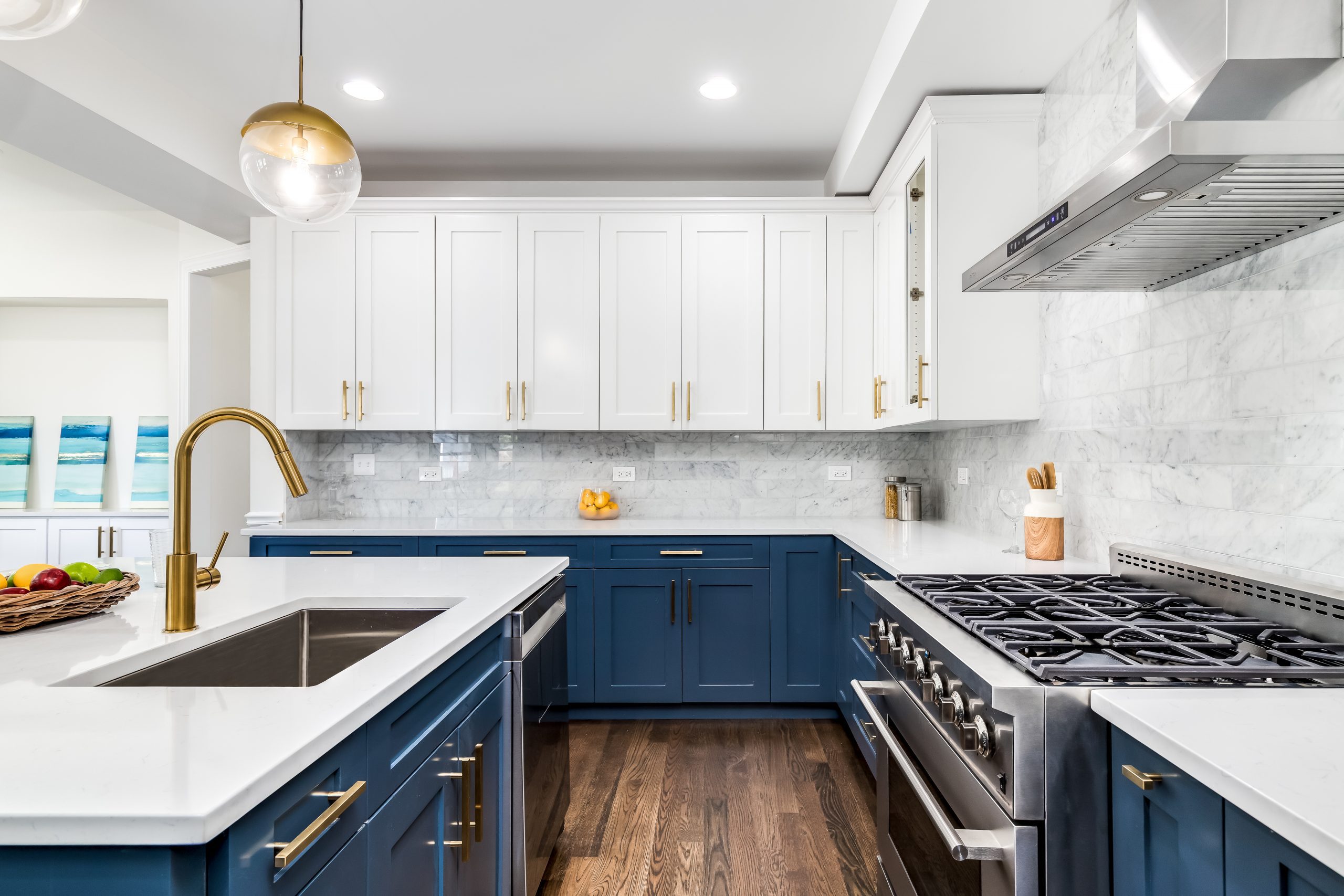
How to Choose Modern Blue and White Kitchen Cabinets
Modern blue and white kitchen cabinets work best when the two colors have separate jobs. White can keep upper cabinetry and large wall areas visually light, while blue can give base cabinets, an island or a pantry wall more definition. The right balance depends on daylight, cabinet style, countertop undertones and how much visual weight the room can support.
For many kitchens, white uppers with blue lowers or a blue island with a white perimeter is a reliable starting point. It is not a universal formula. A bright south-facing kitchen may support deep navy across a larger cabinet run, while a shaded or compact room may feel better with dusty blue, slate blue or a smaller blue feature.
The most important lesson is simple: do not choose the blue and white as isolated paint chips. Test them as part of a material composition that includes the door profile, countertop, backsplash, flooring, hardware and actual lighting.
Contents
- 1 Decide where the blue should go before choosing the shade
- 2 Choose the blue by undertone, not by name
- 3 Pair the blue with the right white
- 4 Match the color split to the cabinet style
- 5 Choose a finish that can handle kitchen use
- 6 Coordinate countertops without making the palette busy
- 7 Let the backsplash support the cabinets
- 8 Use flooring to control warmth and visual weight
- 9 Select hardware that reinforces the design direction
- 10 Test the colors under the lighting you will actually use
- 11 A practical sample-board method
- 12 10 modern blue and white kitchen cabinet ideas
- 12.1 1. Navy island with a warm-white perimeter
- 12.2 2. Slate-blue lowers with white uppers
- 12.3 3. Powder-blue cabinetry with white oak accents
- 12.4 4. A blue pantry wall in an otherwise white kitchen
- 12.5 5. Blue slab bases with handle-light white uppers
- 12.6 6. A furniture-style blue hutch
- 12.7 7. Deep blue inset cabinets with warm metal hardware
- 12.8 8. White cabinets with a blue island and black accents
- 12.9 9. Blue base cabinets with a full-height white slab backsplash
- 12.10 10. A repeated blue built-in beyond the kitchen
- 13 How much blue is right for a small kitchen?
- 14 Plan for daily wear and future maintenance
- 15 Mistakes that make blue and white cabinets look disconnected
- 16 Frequently asked questions
- 16.1 Are blue and white kitchen cabinets still modern?
- 16.2 Which blue is best for kitchen cabinets?
- 16.3 Should upper cabinets be blue or white?
- 16.4 What countertop works with blue and white cabinets?
- 16.5 What hardware looks best with blue and white cabinets?
- 16.6 Can blue and white cabinets work in a small kitchen?
- 16.7 Should the kitchen island match the blue cabinets?
- 16.8 How should I test blue and white cabinet colors?
- 17 Create one coordinated plan before ordering
Decide where the blue should go before choosing the shade
Color placement changes how a kitchen feels. A dark blue island creates a focal point. Blue base cabinets visually ground the working area. Blue tall cabinets can frame a pantry or refrigerator wall. If every cabinet is blue, the white must usually appear through counters, walls or backsplash to preserve contrast.
|
Blue-and-white layout |
Best suited to |
Main advantage |
What to check |
|
White uppers with blue base cabinets |
Galley, L-shaped and medium-size kitchens |
Keeps the upper sightline lighter while grounding the work zone |
Make sure the dividing line is consistent around corners and tall cabinets |
|
White perimeter with a blue island |
Open-plan or larger kitchens |
Creates one clear focal point and is easier to update later |
Confirm the island color works with flooring viewed from adjoining rooms |
|
Blue perimeter with a white island |
Bright rooms with a substantial island |
Makes the island feel furniture-like and visually lighter |
A white island near heavy-use seating may require more frequent cleaning |
|
Blue pantry or appliance wall with white working cabinets |
Kitchens with a distinct tall-cabinet zone |
Turns storage into an architectural feature |
Deep blue can make a tall wall feel heavier, so review it in elevation drawings |
|
Mostly blue cabinets with white counters and walls |
Spacious or well-lit rooms |
Produces an immersive, tailored result |
Provide enough task lighting so the room does not become visually dense at night |
|
Mostly white cabinets with a blue hutch or beverage zone |
Homeowners who want a restrained use of color |
Adds personality without dominating the main kitchen |
Repeat the blue once nearby through art, seating or a small detail |
This distribution decision should be made from cabinet elevations, not only from an inspiration image. Mark the blue areas on each wall, then view the elevations together. A color split that looks balanced on one wall can feel disconnected when it wraps around the room.
If you are still comparing the wider palette, review these kitchen cabinet color ideas for a cohesive remodel before narrowing the options.
Choose the blue by undertone, not by name
“Navy,” “denim” and “slate” are useful descriptions, but product names are not standardized. Two navy samples may have very different green, violet, gray or black undertones. Those differences become obvious beside a white door and a large countertop sample.
|
Blue family |
Typical visual character |
White partner to test first |
Materials that often support it |
Common risk |
|
Inky or deep navy |
Formal, graphic and nearly black in low light |
Soft neutral white |
White oak, walnut, pale quartz, brass or polished nickel |
May read black at night or in a shaded room |
|
Slate blue |
Muted, gray-influenced and adaptable |
Warm-neutral or balanced white |
Greige stone, brushed nickel, medium wood |
Too much gray nearby can make the room feel flat |
|
Dusty denim |
Relaxed, mid-tone and less severe than navy |
Warm white or soft off-white |
Oak, handmade tile, warm metals |
Can look dull under weak or very cool lighting |
|
Powder blue |
Light, fresh and visually gentle |
Clean neutral white |
Pale wood, quiet quartz, chrome or nickel |
An overly sweet palette can feel themed rather than architectural |
|
Teal blue |
Blue with a noticeable green direction |
Creamy or neutral white |
Walnut, warm stone, aged brass |
May compete with green veining or green-gray flooring |
|
Cobalt or saturated blue |
Bold, clear and high energy |
Crisp neutral white |
Simple white surfaces, stainless steel, dark wood |
Can dominate a full kitchen and date faster when overused |
Blue samples should be judged vertically because cabinet doors stand vertically. A sample placed flat on a counter receives light differently and can appear lighter or warmer than it will on the installed cabinetry.
Pair the blue with the right white
White is not a neutral blank. It may lean creamy, gray, blue, green or pink. The wrong white can make a beautiful blue look dirty, overly purple or unexpectedly green.
Use the fixed finishes to narrow the white:
- A countertop with warm cream or gold veining often works better with a soft or warm white than with an icy white.
- A cool gray-and-white surface may support a cleaner neutral white, provided the entire room does not become overly cold.
- Warm wood flooring can bridge deep blue and a soft white.
- Bright white appliances can make an off-white cabinet look more yellow when the two sit directly beside one another.
Benjamin Moore’s guidance on kitchen cabinet paint colors recommends considering countertop undertones when coordinating cabinet colors. That principle applies whether the finish is field-painted, factory-painted or selected from a cabinet manufacturer’s standard range.
Avoid selecting the white first simply because it is popular. Bring the blue, white and countertop together, then remove any option that creates an undertone conflict.
Match the color split to the cabinet style
The same colors can look traditional or contemporary depending on the door profile, overlay and hardware.
Flat-panel or slab cabinets
Flat fronts create broad, uninterrupted color fields. A deep blue slab base with white uppers can feel crisp and modern, especially with restrained edge pulls or integrated channels. Because slab fronts show the finish without decorative shadow lines, surface quality and color consistency matter.
Shaker cabinets
Shaker doors add rail-and-stile shadows that make dark blue appear richer. A narrow, simple Shaker profile feels more contemporary; a wider rail, inset construction or decorative molding moves the result toward transitional or traditional.
Inset or furniture-style cabinetry
Inset doors, latches, cup pulls and visible hinges can turn blue cabinetry into a furniture-like feature. This approach suits a hutch, island or pantry wall when an entire room of detailed blue cabinetry would feel too formal.
Mixed cabinet construction
White uppers and blue bases do not need different door styles to feel distinct. Keeping one door profile throughout usually produces a calmer result. Differences can come through color, hardware size or countertop treatment.
If cabinetry construction is still undecided, compare custom and semi-custom kitchen cabinets before finalizing color availability, modifications and budget.
Choose a finish that can handle kitchen use
Color is only one part of the cabinet specification. The substrate, coating and sheen affect durability, touch-up options, cleanability and how imperfections appear.
Factory finishes can offer controlled application and curing. Site-applied paint may provide more color flexibility and easier future touch-ups, but preparation and curing conditions are critical. When repainting existing cabinetry, door condition, grease removal, adhesion and previous coatings must be assessed before color selection becomes meaningful.
Sheen also changes the blue:
- A lower sheen reduces glare and can make deep blue appear softer, but some very flat finishes are less forgiving in high-touch zones.
- Satin provides a restrained glow and is a common compromise between appearance and maintenance.
- Semi-gloss reflects more light, emphasizes door profiles and may show dents or preparation flaws more clearly.
The correct choice depends on the coating system, not the sheen label alone. Review the manufacturer’s data and compare satin and semi-gloss finishes for kitchen cabinets before specifying the final product.
For existing cabinets, professional assessment is especially important around damaged edges, swelling, failing coatings or doors that need repair. Unique Kitchen & Baths offers cabinet painting services for kitchen updates when the boxes and doors are suitable for refinishing.
Coordinate countertops without making the palette busy
Blue and white cabinetry already creates contrast. The countertop can either connect the two colors or introduce a third strong statement.
Quiet white or off-white quartz
A low-pattern surface lets the cabinet color lead. Check whether the background white matches, supports or clashes with the white cabinet door. Two adjacent whites that are almost the same can look less intentional than a clearly differentiated pairing.
Veined quartz or natural stone
Gray, charcoal, blue-gray or warm taupe veining can bridge the cabinet colors. View the actual slab when possible because a small sample may not reveal the scale and direction of the pattern.
Dark countertops
A dark counter over blue base cabinets creates a visually heavy block. It can be striking in a bright kitchen, but it needs adequate lighting and enough pale surfaces elsewhere. On a blue island, a dark top may make the island feel larger and more anchored.
For material performance as well as appearance, compare quartz and granite countertop characteristics before selecting a slab.
Let the backsplash support the cabinets
The backsplash sits directly beside both cabinetry and countertop, so even a small undertone mismatch becomes visible.
Useful approaches include:
- warm white handmade-look tile with dusty or slate blue;
- a quiet white large-format tile with saturated navy;
- a full-height counter slab for fewer seams and less visual competition;
- restrained blue-patterned tile in a mostly white kitchen;
- pale gray-blue tile when the cabinets are a deeper, cleaner navy.
Avoid choosing a blue backsplash that is almost, but not quite, the cabinet color unless the variation is clearly intentional. A related lighter or grayer blue is usually easier to read as a deliberate layer.
If the backsplash will carry more personality, use these colorful kitchen backsplash ideas to compare pattern scale and placement.
Use flooring to control warmth and visual weight
Wood and wood-look floors are effective bridges between cool blue and white. White oak supports lighter and gray-influenced blues, while walnut and medium brown floors can warm deep navy. A very orange floor may make a blue cabinet look more intense because the colors oppose one another.
Tile can work equally well when its undertone belongs to the cabinet palette. Before selecting a gray tile, compare it beside the blue. Some grays turn noticeably green, violet or brown in context.
Review the maintenance and visual differences among kitchen flooring options for remodeling before using color as the only deciding factor.
Select hardware that reinforces the design direction
Hardware can make blue-and-white cabinets feel coastal, traditional, industrial or minimal.
|
Hardware finish |
Effect with blue and white cabinets |
Best fit |
Detail to verify |
|
Matte black |
Adds crisp graphic contrast |
Modern and transitional |
Compare different black coatings side by side because they may not match |
|
Polished nickel |
Reflective and tailored |
Transitional and traditional |
Keep the sheen coordinated with plumbing when the pieces are close together |
|
Brushed nickel or stainless |
Quiet and practical |
Contemporary and understated rooms |
Check whether the finish looks too cool beside a creamy white |
|
Aged or satin brass |
Adds warmth and contrast |
Navy, slate and teal palettes |
Use a controlled number of warm-metal accents to avoid visual clutter |
|
Bronze |
Deep and subtle |
Warm whites and muted blues |
Make sure it remains distinct from the blue rather than disappearing into it |
For a sharper palette, black hardware can connect blue base cabinets to white uppers. The principles in this guide to white kitchen cabinets with black hardware also apply to mixed blue-and-white cabinetry.
Test the colors under the lighting you will actually use
Blue can move toward black, green, gray or violet as the light changes. White can shift from crisp to cream within the same day. A room with strong afternoon sun may support a deeper color than a north-facing room or a kitchen relying heavily on artificial light.
The U.S. Department of Energy explains that correlated color temperature describes the apparent warmth or coolness of a lamp, while color rendering describes how a light source affects the appearance of objects. Its lighting selection guidance also notes that large changes in color temperature are noticeable.
Test the sample arrangement:
- In morning, midday and evening daylight.
- Under ceiling lights and undercabinet task lighting.
- Beside the planned countertop, backsplash and floor.
- On different walls, because orientation changes reflected color.
- With nearby lights dimmed and at full output.
Do not use a high-gloss white cabinet as a substitute for a proper lighting plan. Resolve fixture locations, switch zones and task lighting early with this kitchen electrical and lighting planning resource.
A practical sample-board method
Online inspiration is useful for direction, but screens cannot reliably reproduce paint color, sheen, stone movement or room light. Build a physical sample board before ordering cabinets.
Include:
- a full door sample in the blue finish;
- a full door sample in the white finish;
- the actual hardware finish;
- a countertop sample or slab photograph with accurate scale;
- backsplash tile and grout;
- flooring;
- metal samples for the faucet and lighting.
Keep the door samples vertical and the countertop sample horizontal. This approximates the way each surface receives light. View the board from normal standing distance, then move it beside each cabinet run.
The National Kitchen & Bath Association’s kitchen and bath planning guidelines cover cabinetry, finishes, functional storage, lighting and systems coordination. That broader planning approach matters because a cabinet palette should support the kitchen’s use, clearances and equipment, not distract from unresolved layout problems.
10 modern blue and white kitchen cabinet ideas
These are adaptable design formulas, not rules. Each can be adjusted for room size, architecture and existing finishes.
1. Navy island with a warm-white perimeter
Use navy as the room’s focal point and keep perimeter cabinetry soft white. Add white oak seating or flooring to prevent the contrast from feeling severe. A pale counter with restrained movement can tie both cabinet colors together.
2. Slate-blue lowers with white uppers
This arrangement grounds the work zone while keeping the upper sightline lighter. It suits galley and L-shaped kitchens when the blue transition remains consistent across corners and appliance openings.
3. Powder-blue cabinetry with white oak accents
Pale blue feels more architectural when paired with natural wood and a clean white counter rather than themed coastal decor. Use simple hardware and avoid filling the room with multiple competing pastel colors.
4. A blue pantry wall in an otherwise white kitchen
Treat tall storage as one continuous block of color. This can frame a refrigerator, conceal a pantry door or distinguish a beverage zone. Review the entire wall elevation because a dark bank of tall cabinets carries more visual weight than a blue island.
5. Blue slab bases with handle-light white uppers
Combine flat-panel blue lower cabinets with white slab uppers and discreet edge pulls. Align reveals, appliance panels and pull lengths carefully so the color split feels precise.
6. A furniture-style blue hutch
Use blue on a glass-front hutch, coffee bar or dining-side cabinet while keeping the working kitchen white. A contrasting counter or warm metal hardware can reinforce the furniture effect.
7. Deep blue inset cabinets with warm metal hardware
Inset doors and aged or satin brass hardware produce a tailored, layered result. Use this combination selectively if the room is small or shaded, and test how the blue reads under evening light.
8. White cabinets with a blue island and black accents
Black-framed windows, slim pendants or cabinet pulls can give the blue-and-white palette a more graphic edge. Repeat black in a few intentional places rather than making every fixture match.
9. Blue base cabinets with a full-height white slab backsplash
A continuous pale backsplash reduces visual seams and lets the cabinetry lead. Coordinate the slab’s background with the white upper doors and plan outlet positions before fabrication.
10. A repeated blue built-in beyond the kitchen
In an open-plan home, repeat the cabinet blue on a nearby bar, media unit or dining built-in. The repetition connects spaces without requiring identical furniture or decor throughout.
How much blue is right for a small kitchen?
Small kitchens do not require pale cabinets, and deep blue does not automatically make a room feel cramped. The result depends on where the dark color sits, how continuous the cabinet runs are, how much daylight is available and whether the counters and work surfaces remain visually clear.
A practical small-kitchen strategy is to use blue on lower cabinets, keep upper cabinetry or walls white and provide continuous task lighting. Another is to concentrate blue on one short cabinet run. If the room has little daylight, compare navy against a mid-tone slate or dusty blue before assuming the darkest option will deliver the desired effect.
Plan for daily wear and future maintenance
Dark painted finishes can reveal dust, flour, dried water spots and edge wear. White doors can reveal splashes and fingerprints. Both need routine, finish-safe care.
- Follow the cabinet or coating manufacturer’s cleaning instructions.
- Use a soft cloth and an approved mild cleaner.
- Dry around knobs, pulls, sink bases and dishwasher edges.
- Avoid abrasive pads and harsh chemicals unless explicitly approved.
- Tighten loose hardware before movement damages the finish around mounting holes.
- Keep touch-up material labeled with the product, color, sheen and application date.
If children, pets or heavy cooking make durability a priority, compare door materials and sample finishes before focusing on color. The best blue is not useful if the coating or substrate does not suit the household.
Mistakes that make blue and white cabinets look disconnected
- Choosing color names instead of physical samples: a navy label does not reveal the undertone.
- Ignoring adjacent whites: cabinets, counters, walls and appliances may all be different whites.
- Splitting color without a clear boundary: random blue doors can look like replacements rather than a composition.
- Using too many blue shades: several almost-matching blues usually create visual noise.
- Testing samples flat: vertical doors and horizontal counters receive light differently.
- Selecting hardware last: pull shape, scale and finish can change the entire style direction.
- Forgetting nighttime conditions: a blue that looks rich by day may read black under weak lighting.
- Overloading the room with pattern: strong cabinetry, dramatic stone and patterned tile compete for attention.
- Treating color as a layout fix: attractive finishes do not solve poor storage, clearances or workflow.
Frequently asked questions
Are blue and white kitchen cabinets still modern?
Yes. The combination can feel current because it is adaptable rather than tied to one door style. Flat-panel fronts, restrained hardware and simple surfaces create a modern result, while Shaker or inset doors move the same palette toward transitional or traditional design.
Which blue is best for kitchen cabinets?
There is no single best blue. Deep navy suits bright rooms and focal islands; slate and dusty blue are more forgiving in varied light; powder blue creates a lighter effect; teal works when its green undertone supports the surrounding materials. Test the finish in the actual room.
Should upper cabinets be blue or white?
White uppers can keep the upper sightline lighter, while blue uppers create a more immersive color statement. Decide from the full wall elevation, available daylight and the number of tall cabinets rather than using a universal rule.
What countertop works with blue and white cabinets?
Quiet white, off-white and lightly veined surfaces are flexible choices. Warm veining can soften navy; gray or charcoal veining can connect cool blue with white. Compare full-size samples because two adjacent whites can clash even when each looks neutral alone.
What hardware looks best with blue and white cabinets?
Matte black creates graphic contrast, polished nickel feels tailored, brushed nickel is understated and brass adds warmth. Select the finish according to the cabinet style and repeat it intentionally. Exact matching across different manufacturers is not always possible.
Can blue and white cabinets work in a small kitchen?
Yes. Control the amount and location of blue, preserve useful task lighting and avoid unnecessary countertop clutter. Blue lowers with white uppers or one blue feature zone can add depth without making every wall visually heavy.
Should the kitchen island match the blue cabinets?
It can, but it does not have to. A blue island can be the only colored element in a white kitchen, or it can repeat blue base cabinets. If the island uses a different blue, make the distinction clear enough to look intentional.
How should I test blue and white cabinet colors?
Use full cabinet-door samples with the planned countertop, backsplash, grout, floor and hardware. Keep door samples vertical, review them on each wall and observe them in daylight and artificial light over several days.
Create one coordinated plan before ordering
The strongest modern blue and white kitchen cabinets are selected as part of the complete room. Color placement, undertones, door style, finish, countertop, backsplash, flooring, hardware and lighting should support one another. A physical sample board and complete cabinet elevations can prevent expensive surprises that small paint chips do not reveal.
Ready to compare blue, white and material samples for your Orange County home? Request a kitchen remodeling consultation.